When a child or teen comes in with crowded teeth, the most common recommendation at many orthodontic offices is straightforward: pull a few teeth to make room, then straighten what remains. It’s a familiar approach, and for decades it was considered standard care.
At Santucci Orthodontics, we see it differently. Crowding is rarely the problem. It’s a signal that something else is going on. And in most cases, removing healthy permanent teeth to manage that signal isn’t the most thoughtful solution.
Non-extraction orthodontics is built on a different premise: that a well-developed jaw has enough room for all of its teeth, and that when it doesn’t, the right response is to address the underlying cause rather than remove the evidence.
Crowding Is a Symptom
Think of crowded teeth the way you might think of a symptom in any other part of health. A headache isn’t the problem. Something is causing it. Crowded teeth aren’t the problem either. They’re the visible result of an arch that hasn’t developed to its full potential, a jaw that grew too narrow, or a pattern of oral habits and airway function that shaped the bones over time.
When teeth crowd, it’s because there isn’t enough space in the dental arch for them to emerge properly. Traditional orthodontics addressed this by creating space the only way it could at the time: by removing teeth. Modern orthodontic thinking, and the tools that support it, has changed what’s possible.
The question isn’t how to fit the teeth you have into the space that exists. The question is why the space isn’t there, and whether it can be created.
What Non-Extraction Orthodontics Actually Involves
Non-extraction treatment doesn’t mean ignoring the problem or hoping things resolve on their own. It means treating the cause of crowding rather than its consequence.
Depending on the patient and their age, this might involve:
Arch development and expansion. The upper and lower jaws can be gently guided to grow wider and longer, creating space for teeth to emerge naturally and position correctly. In younger patients, this happens with the help of the natural growth process. In older teens and adults, it may involve more specialized appliances.
Early intervention. For children, growth is an asset. Between the ages of seven and ten, the jaws are still developing and highly responsive. Strategic early treatment (sometimes called Phase I orthodontics) can guide jaw growth during this window in ways that aren’t possible once growth is complete. This often reduces the complexity of treatment later and eliminates the need for extractions entirely.
Specialized appliances and techniques. At Santucci Orthodontics, we use tools well beyond traditional brackets and wires to create space, guide movement, and achieve stable results. This includes appliances designed to work with the body’s natural biology rather than against it.
The goal in every case is the same: a stable, well-aligned result that fits the patient’s face, supports their airway, and lasts.
Why Removing Healthy Teeth Has Real Consequences
Extracting teeth to resolve crowding isn’t without cost. When permanent teeth are removed, the arch becomes narrower. A narrower arch can pull the lips and cheeks inward, affecting the profile and the overall balance of the face. For some patients, especially younger ones, this changes the way the face develops, and those changes are permanent.
There’s also the relationship between arch width and airway. A narrow palate can restrict the nasal airway, which affects breathing, particularly during sleep. For patients who already show signs of airway concerns, extracting teeth and narrowing an already compromised arch can worsen what was already a structural issue.
Non-extraction orthodontics, when appropriate, works in the direction of expansion rather than reduction. That typically means a broader smile, better lip support, improved facial harmony, and an airway that has more room to function.
Is Non-Extraction Orthodontics Right for Everyone?
Honest answer: no. There are cases where extractions are genuinely the right choice, particularly where skeletal discrepancies are severe enough that expansion alone cannot achieve a stable result, or where surgical options may also need to be considered.
At Santucci Orthodontics, the goal isn’t to avoid extractions at all costs. The goal is to determine the actual cause of crowding for each individual patient and recommend the approach that produces the best long-term outcome for that person specifically. Sometimes that’s non-extraction. Sometimes it isn’t.
What we won’t do is recommend extracting healthy, permanent teeth as a default response to crowding without first understanding what’s driving it.
The Difference Timing Makes
One of the most important factors in non-extraction treatment is timing. For children, the jaw is still actively growing, which means it can often be shaped. Treatment that works with natural growth (guiding the arch, creating space, and addressing oral habits) during this window can prevent crowding from becoming severe in the first place.
For teens whose growth is still ongoing, many non-extraction approaches remain available. For adults whose growth is complete, options are more limited but still exist, including more advanced appliances designed to create expansion in a fully developed jaw.
This is why we recommend that children be seen for an orthodontic evaluation by age seven. Not because treatment necessarily begins then, but because understanding what’s developing, and what might need guidance, is far more valuable early than it is later.
What a Thorough Evaluation Actually Looks Like
Non-extraction orthodontics begins with a different kind of question at the consultation. Rather than asking “how do we make room?” the evaluation starts with “why isn’t there room?”
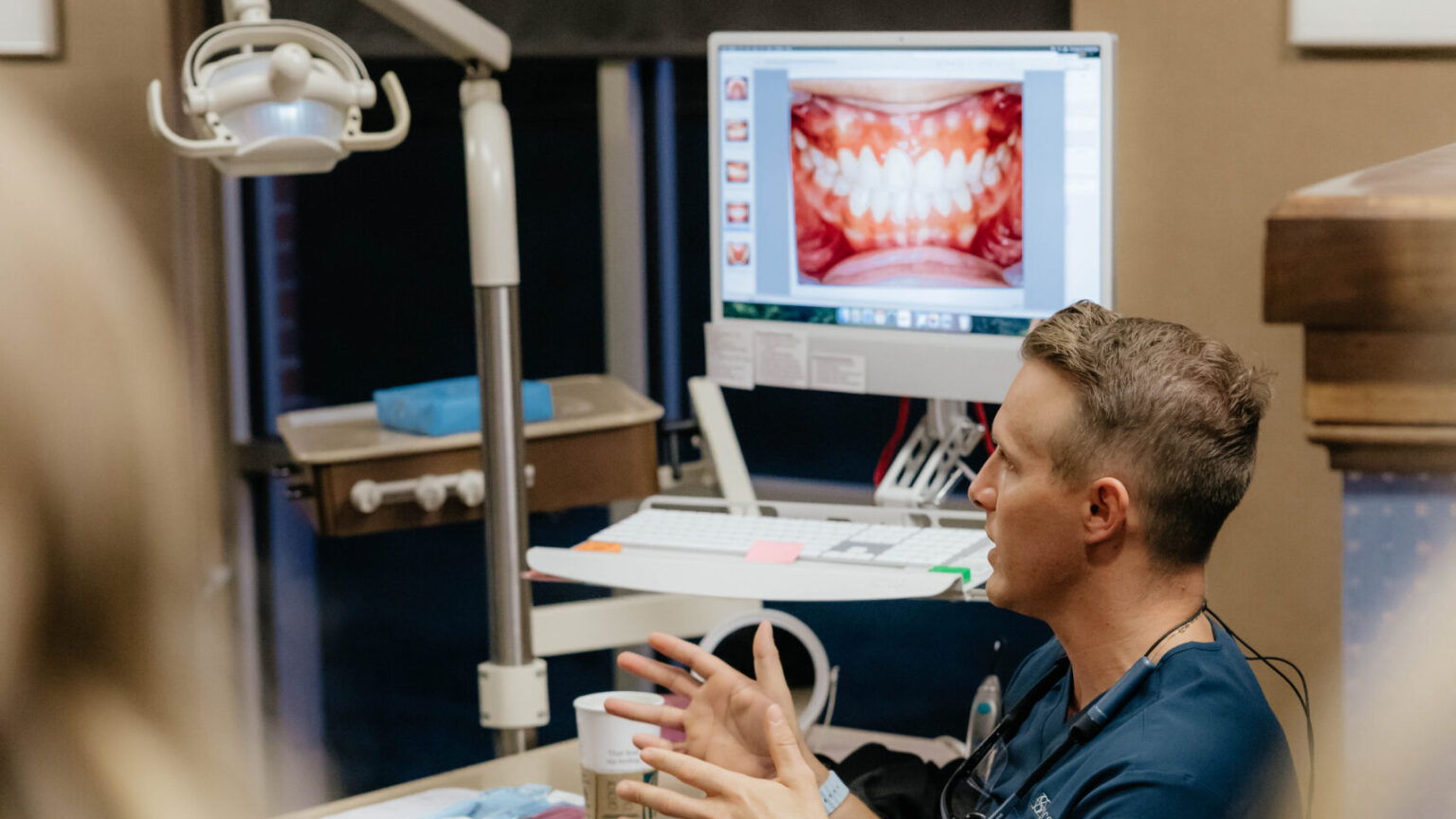
That means looking at the relationship between the upper and lower jaws, the position of the teeth within the bone, the width of the arch, the posture of the tongue and lips, and, where relevant, the airway. Digital imaging gives us a complete picture of what’s happening beneath the surface, not just what’s visible when a patient smiles.
Treatment planning from that foundation produces something different: a recommendation that addresses the actual structure of the smile rather than its surface-level appearance.
Built Around Long-Term Results
The outcomes that matter most in orthodontics aren’t visible the day braces come off. They’re visible years later: in a bite that remains stable, a smile that still fits the face, teeth that haven’t shifted because the underlying structure was never truly corrected.
Non-extraction orthodontics, when approached thoughtfully, tends to produce more stable long-term results because it addresses the root cause of crowding rather than working around it. Teeth that are properly positioned within a well-developed arch have less tendency to shift because the forces acting on them are more balanced.
That’s the philosophy behind everything we do at Santucci Orthodontics: results that are built to last, not just designed to look good at debond.
Learn More at Santucci Orthodontics
If you or your child has been told that tooth extractions are the only path forward for crowded teeth, we would encourage you to hear a second opinion. The answer may be the same. It may not be.
What sets us apart is a commitment to understanding each case fully before recommending treatment, and to using every tool available before concluding that a healthy tooth should be removed.
We serve families throughout Wichita from our East and West Wichita locations, and we offer complimentary consultations for patients of all ages.